
Article Summary:
Pilot cars are essential safety companions for oversized shipments on Canadian roads. Each province has slightly varying rules and regulations for when a pilot car is needed, how many are required, and which position they need to travel in. The point of a pilot car is to stay in contact with the driver and help navigate the planned route, traffic, and any potential obstacles or hazards on the roads.
Inside this article:
- What are pilot cars?
- How to become a pilot car driver
- The requirements of a pilot car driver
- How to find a pilot car driver for your oversized shipment
- Pilot car requirements by province
Pilot Cars Are Essential for Safe Heavy Hauling
Have you ever heard of a pilot car? If you’ve dealt with transporting oversized loads before, then you probably have, but maybe you don’t know what they are. Or perhaps you’re new to transporting oversized loads, and this is all nonsense to you so far. Chances are, you’ve seen a pilot car on the road before. Trusted Dispatch is here to help clear up the confusion so that you can gain a better understanding of hauling oversized loads and increase your confidence in the heavy haul trucking industry. Let’s dive into the details.
What is a Pilot Car?
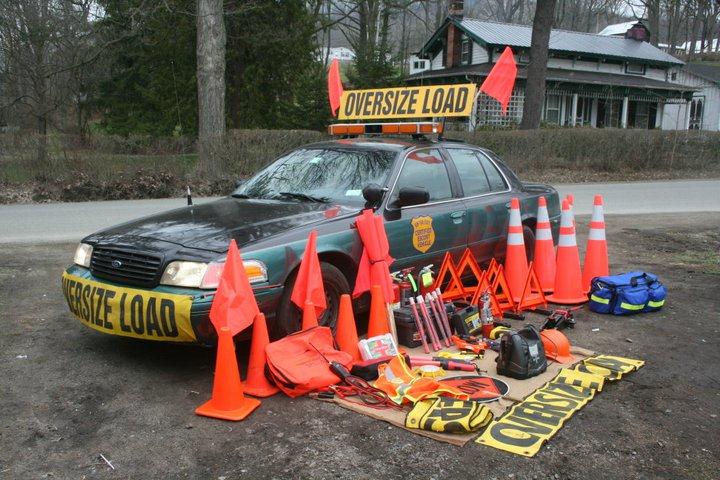
Those cars you see driving ahead of oversized loads, usually with signage and flashing lights, are pilot cars. These cars are driven by specially trained drivers that work together with truck drivers to keep the oversized load safe on the road. They drive either in front of the load, behind it, or both. They stay connected to their truck drivers via a CB radio and manage many different tasks. They make sure the load, as well as other traffic, is safe along the route, minimize delays, and monitor potential road obstructions. It takes a trained driver with an excellent ability to multitask to be a pilot car driver.
Oversized Loads and Safety Hazards
Oversized loads, such as a harvester combine, can be a considerable safety hazard without the careful monitoring of a pilot car. It becomes unsafe for truck drivers to perform manoeuvres such as lane changes or parking. And when loads become particularly tall, it is essential to make sure that the load can clear obstacles such as bridges and tunnels.
Pilot Cars in Front of the Load
Pilot cars that travel in front of the load serve to warn oncoming traffic of the load and to warn the truck driver of any upcoming hazards or obstructions. They also make sure that the correct route is being followed, and they find safe places for the truck driver to pull over.
Pilot Cars at the Back of the Load
Pilot cars travelling in the rear warn traffic behind the oversized load and keep an eye out for hazards in the back, such as flat tires or the load coming loose. They also keep the truck driver informed of vehicles attempting to pass.
Challenges of Driving Pilot Cars
As a pilot car driver, it can become increasingly challenging to manage road conditions when fatigue starts to set in. You have to be adaptable to varying road conditions, terrain, and unexpected events. To be a pilot car driver, you should be able to multitask, communicate effectively, think ahead, and problem-solve.
Becoming a Pilot Car Driver
Working as a driver of an escort car typically requires a high school diploma and a valid driver’s license. Some companies may also need a commercial driver’s license (CDL). Depending on where the driver is hired, job-specific training may or may not be provided by the company.
A significant issue with the profession, however, is that it is often under-regulated as compared to trucking. As a matter of fact, Ontario is the only province that requires drivers to be Certified Superload Escorts in order to escort a superload (a larger type of oversized load). Otherwise, there are not often many requirements for escorting an oversized load. It can also be difficult to find insured drivers since insurers can be reluctant to insure drivers in this line of work. Many people in the heavy haul industry are pushing for tighter regulations for the training of pilot car drivers to keep the roads safer. It is vital for pilot car drivers to be properly trained and have all the necessary equipment with them in order to prevent serious accidents. The North American Pilot Vehicle Safety Alliance (NAPVSA) and National Pilot Car Association (NAPCA) are organizations representing pilot car workers, and they work towards improving regulations, training, and safety.
Equipment for Pilot Cars
In order to be prepared for even the most unexpected of events on the road, there is a list of supplies that pilot drivers must have in their cars while on the road.
First and foremost, the car must be outfitted with signage indicating the presence of an oversized load. In addition, there should be brightly coloured flags and flashing lights to draw others’ attention. In the case of a particularly tall oversized load, a pole will be added to the car so that it can test the clearance of bridges, low-hanging wires, tunnels, and other potential obstacles for the load. Without such safety measures, other drivers may not be sufficiently warned about the load, the truck driver may not be able to make manoeuvres safely, or the lack of a height pole could cause dangerous and highly disruptive and messy traffic accidents.
Further safety equipment is included inside the car, such as maps, in case of GPS issues. There also needs to be a fire extinguisher, first aid kit, and a CB radio for the pilot car to communicate with the truck driver.
Finding Pilot Cars
There are usually pilot car service directories for each province that you are working in. For example, the yellow pages have guides for the province you’re working in. When you work with Trusted Dispatch, the driver will typically find a pilot car driver they know and trust.
Pilot Car Requirements per Province
Due to Canada’s vastly varying terrain and conditions, the oversized load requirements and pilot car requirements change from province to province. To help you learn the details, here’s a quick run-down of the oversized load and pilot car requirements for each province.
British Columbia
British Columbia is known for its beautiful terrain, which ranges from mountains to stretching coastlines and is connected by winding roads. This is the most different terrain as compared to the rest of Western Canada, so the oversized load and pilot car requirements are a bit different.
Oversized Load Requirements:
Overall height: 4.15 m or 13′ 6″
Overall length: 23 m or 75′
Overall width: 2.6 m or 8′ 6
Pilot Car Requirements:
The requirements for a pilot car or escort vehicle in British Columbia depend on the route being travelled, so if a load is being transported through British Columbia, surveying the route beforehand is essential. If the route includes lots of winding roads, blind hills, or sharp turns, it’s more likely that an escort car will be needed to drive ahead and warn oncoming traffic of the load and monitor road conditions for the truck driver.
Alberta
Most of Alberta is fairly flat, with the occasional valleys. However, if you’re hauling to BC or on the Western edge of the province, your driver may also have to navigate mountainous terrain. Here are Alberta’s requirements.
Oversized Load Requirements:
Overall height: 4.15 m or 13′ 6″
Overall length: 23 m or 75′ to 27.5m or 90′
Overall width: 2.6 m or 8’6″
Pilot Car Requirements:
Alberta sets escort requirements by load width, and the answer changes depending on whether you are on a two-lane or a multi-lane highway.
Loads over 3.85 m (12′7″) wide need one escort: a pilot vehicle in front on a two-lane highway, or a trail vehicle behind on a multi-lane highway.
Loads over 4.45 m (14′7″) wide need a pilot in front and a trail behind on a two-lane highway. On a multi-lane highway one trail vehicle is enough up to 5.49 m; past that you need both a pilot and a trail vehicle. Loads over 4.45 m may only move during daylight unless the Central Permit Office authorises otherwise.
Below 3.85 m no escort is required, but warning flags, lights, and dimensional signs come in progressively at 2.60 m, 3.05 m, and 3.35 m.
In Alberta, loads over 3.85 m wide cannot move between 3:00 pm and midnight on any day before a weekend or a statutory holiday, and cannot move at all on a Sunday or a statutory holiday. Plan pickup and delivery dates around this — it is the single most common cause of a heavy-haul schedule slipping a day in Alberta.
Saskatchewan
Oversized Load Requirements:
Overall height: 4.15 m or 13′ 6″
Overall length: 12.5 m or 41′ for a single vehicle; 23 m or 75′ for a combination; 26 m or 85′ for an A or C train; 27.5 m or 90′ for a B train
Overall width: 2.6 m or 8′ 6″
Pilot Car Requirements:
When oversized loads are being transported in Saskatchewan, guidelines determine whether one or two pilot cars are needed and whether the car is in the front, back, or both. This depends on whether the highway is two or four lanes and the time of day of the transportation. Figuring out these rules is something that your driver at Trusted Dispatch will be able to help you with.
Manitoba
Oversized Load Requirements:
Overall height: 4.15 m or 13′ 6″
Overall length: 12 m or 40′ to 20 m or 65′
Overall width: 2.6 m or 8′ 6″
Pilot Car Requirements:
Via the government of Manitoba, pilot car rules and requirements are clearly stated. There are details on when pilot cars are required and which flashing lights, bright flags, and signage are required on the car and on the oversized load. It also goes over driving restrictions which usually relate to peak travel times.
For example, when a load exceeds 2.6 m in width, flags must be attached to the four corners of the load, and flashing lights must be attached at night.
Manitoba sets escort requirements by width and by whether the highway is divided. At 3.70 m wide, a front pilot is required in daylight on undivided highways if the load overhangs the centre line; at night, front and rear pilots are required on undivided highways and a rear pilot on divided highways. At 4.60 m, daytime travel needs front and rear pilots on undivided highways and a rear pilot on divided highways, and no night travel is permitted. At 6.10 m, front and rear pilots are required. Loads over 2.60 m are subject to Winnipeg rush-hour restrictions, and a police escort may be required within Winnipeg.
Ontario
Oversized Load Requirements:
Overall height: 4.15 m or 13′ 6″
Overall length: 12.5 m or 41′ to 23m or 75′
Overall width: 2.6 m or 8′ 6″
Pilot Car Requirements:
Pilot car requirements in Ontario depend mainly on the width of the load and the number of lanes on the highway. No escort is required for widths from 2.61 m up to 3.99 m. One escort vehicle is required for loads 4.00 m to 4.99 m wide on a multi-lane highway, or 4.00 m to 4.59 m wide on a two-lane highway. Two escort vehicles are required for loads 4.60 m to 4.99 m wide on a two-lane highway. At 5.00 m and wider, Ontario requires Certified Superload Escorts.
Quebec
Oversized Load Requirements:
Overall height: 4.15 m or 13’6″
Overall length: 23 m or 75′
Overall width: 2.6 m or 8′ 6″
Pilot Car Requirements:
Quebec keys its escort rules to the number of lanes running in your direction of travel. An escort must travel in front when the load is over 3.75 m wide on a road with a single lane in the direction of travel, or when it is between 3.10 m and 3.75 m wide and travelling at night on such a road. An escort must follow behind when the load is over 3.75 m wide on a road with more than one lane in the direction of travel. Escorts are also required for height over 4.50 m and for length over 17 m for a single vehicle, 21 m for a crane, or 27.5 m for a two-vehicle combination.
New Brunswick
Oversized Load Requirements:
Overall height: 4.15 m or 13’6″
Overall length: 12.5 m or 41′ to 23 m or 75′
Overall width: 2.6 m or 8′ 6″
Pilot Car Requirements:
On two-lane highways, one pilot car is required for loads wider than 3.65 m, and two pilot cars are required for loads wider than 4.88 m. On multi-lane highways, loads exceeding 3.05 m in width must be accompanied by a pilot car at night. Otherwise, a pilot car must accompany loads exceeding 3.65 m in width.
Nova Scotia
Oversized Load Requirements:
Overall height: 4.15 m or 13’6″
Overall length: 14.6 m or 48′
Overall width: 2.6 m or 8′ 6″
Pilot Car Requirements:
Nova Scotia assigns escort conditions per permit, by width band. Below 3.05 m no escort is required. From 3.05 m to 3.66 m an escort is required at night only — front on two-lane roads, rear on multi-lane. From 3.66 m to 4.88 m the same applies during the day, with front and rear escorts at night. Front and rear escorts during daytime travel on two-lane roads start at 4.88 m. Loads over 5.5 m wide are single-trip only and may generally travel between 3:00 a.m. and 9:00 a.m. on Sundays; nothing over 9.1 m wide is permitted on any road.
Reliable Oversized Load Transport in Canada
If you need help getting your oversized load transported in Canada, Trusted Dispatch is the one to call. We provide fair rates, an easy, straightforward process, and expert drivers. The drivers in our network are highly knowledgeable and experienced and will be able to help you plan your heavy haul.
Trusted Dispatch operates with a load board—sort of like the Uber of heavy haul trucking. You post your load details to the board, and a capable and interested driver will pick it up and work with you to plan the load and get it on the road.
Our process is very straightforward. You can start by getting a quote from us, and that’s a simple three-step process. First, you need to input the dimensions of your machine (height, weight, width, and length). Next, input your pick-up location, and finally, input your drop-off location.
To work with a professional and experienced heavy-haul company, come to Trusted Dispatch. We are available to answer questions and discuss all things heavy-haul via phone, email and online chat. Get started with your free, instant quote today!
Provincial figures verified against government sources in July 2026. Regulations change — confirm current thresholds with the issuing province before you move.
For current oversize-load permit thresholds and regulations, see oversize.io.